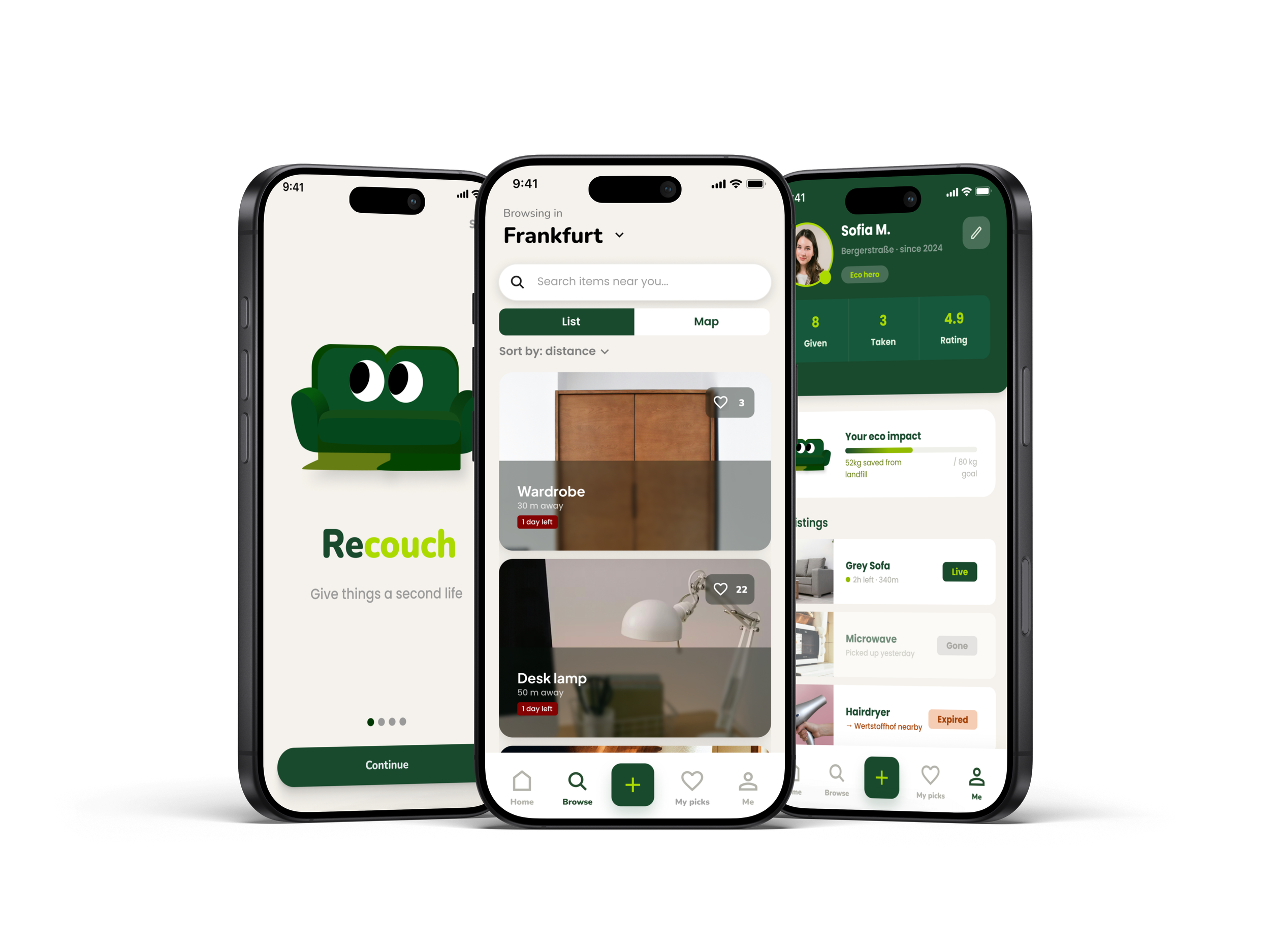
Recouch is a hyperlocal platform that gives household items and furniture a second life by connecting people who want to quickly give away usable pieces with others who can pick them up for free. It helps keep perfectly good items out of the waste stream while also offering a fast, practical solution for decluttering. If no one claims an item, it remains registered for bulk waste collection (Sperrmüll), ensuring it is still removed efficiently.
Recouch.
Give things
a second life.
UX/UI Design
SOLO DESIGN
TOOL
Figma
Germany
22+
CONTEXT
SCREENS
In Germany, there's a system for bulky waste called Sperrmüll. Residents request a collection date, and the city assigns one, usually within days or weeks. Items only go out the day before, or the morning of pickup. Walking through Frankfurt, I kept seeing the same thing: sofas in good condition, working lamps, wardrobes with years left in them. Some waiting for the truck, others with a "zu verschenken" tag, free to take. But most of them were still there when the truck arrived.
01 · THE PROBLEM
Good stuff ends up in the trash.
DISCOVERY
That lamp you need might be two streets away, on a route you never take. You'll never know it was there.
TRUST
No way to know if something has been outside for two hours or two days. In a rainy city, that uncertainty is enough to walk past.
AWARENESS
Objects don't end up as waste because they're broken. They end up as waste because the right information never reaches the right person at the right time. And so they sit on the pavement for days, sometimes weeks, until the city comes to take them away.
Many residents don't know how Sperrmüll works, or feel guilty leaving good items out. Either way, things that could have a second life end up as street waste.
"I've found great stuff on the street but I always arrive too late."
FRANKFURT RESIDENT, INTERVIEW
02 · HOW IT WAS MADE
Five honest steps.
01
Conversations with locals and expats living in Frankfurt. Observed how Sperrmüll and "zu verschenken" actually play out on the street.
02
Identified the real friction: not goodwill, but the missing connection between giver and finder. Reframed the JTBD around the window before the truck.
03
Two parallel publishing flows split by one human question "can one person carry it alone?" Killed an early chat-first direction.
04
Cream + dark green, with a lime accent for action. Built around Remy, a geometric sofa mascot that keeps the tone light without being dishonest about waste.
05
22 screens across 6 flows in Figma. Hand-drawn icons, purple as a second-language for small items, real photos in browse and saved.
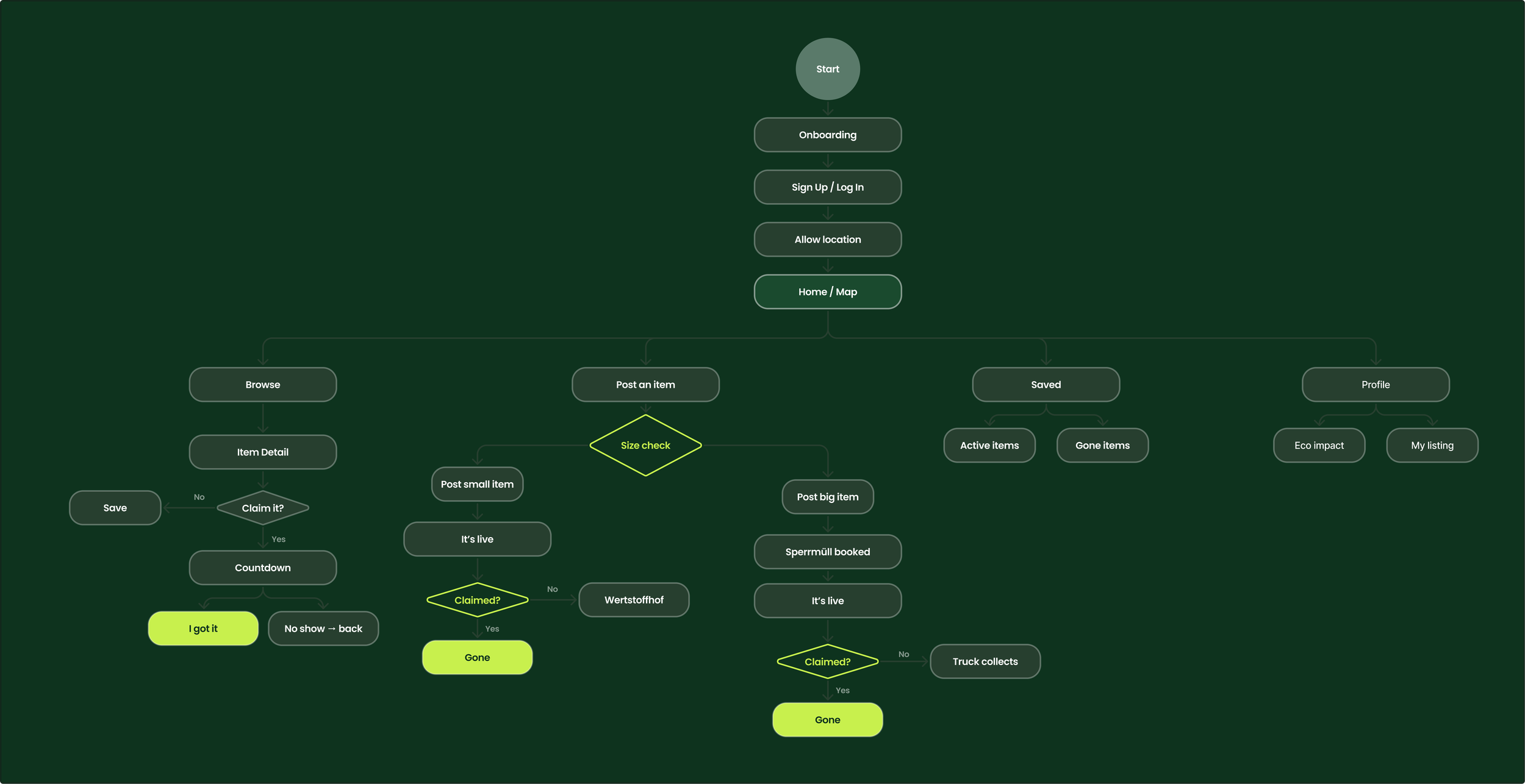
03 · USER FLOW
04 · DESIGN SYSTEM
Sustainability as urgency, not guilt.
The app deals with waste, which can feel heavy. The visual system needed to make action feel easy and even satisfying without pretending the problem isn't real. Cream backgrounds, deep green for trust, lime for action, purple for small items.
Couch green / brand
#1B4B2F
Chartreuse / impact
#AADA00
Sage / surface light
#E2EEDD
Cream / surface
#F5F2EC
Lavender / small items
#DEDDFF
Mute / secondary
#B4B4AB
Nunito
Display · 800 weight · slight roundness keeps things friendly
Poppins
UI & Body · 400 / 600 / 700 · neutral, generous x-height
05 · THE FLOWS
From first open to item gone.
Six flows covering every path a user might take, from discovering something nearby to giving something away before the truck arrives.
Flow 01
Onboarding
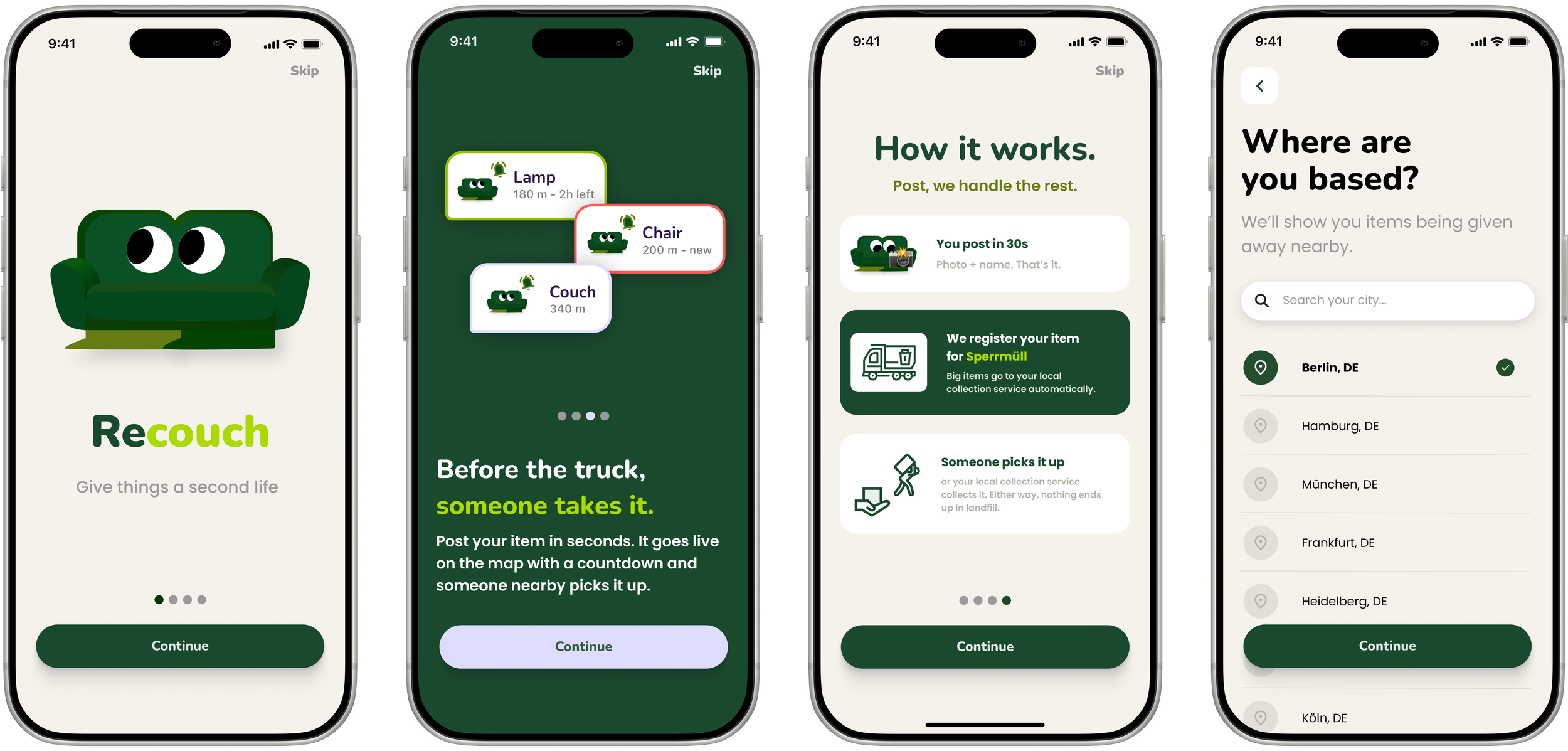
Splash → "before the truck" → how it works → where are you based. No friction wall, the value is visible before the form.
Flow 02
Browse & discover
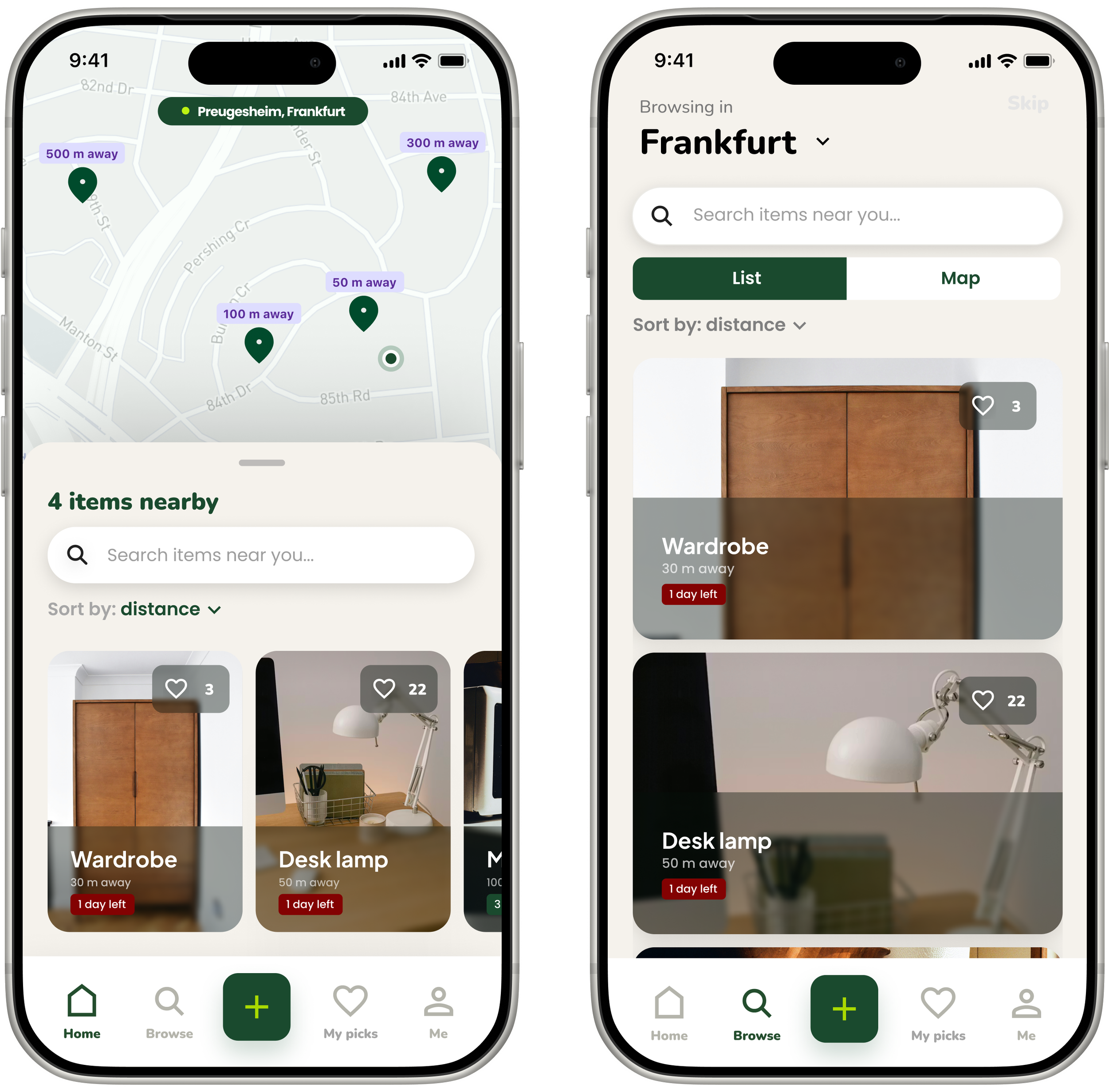
List or map view, items with countdowns. The decision to go pick something up is always visual first.
Flow 03
Claim flow
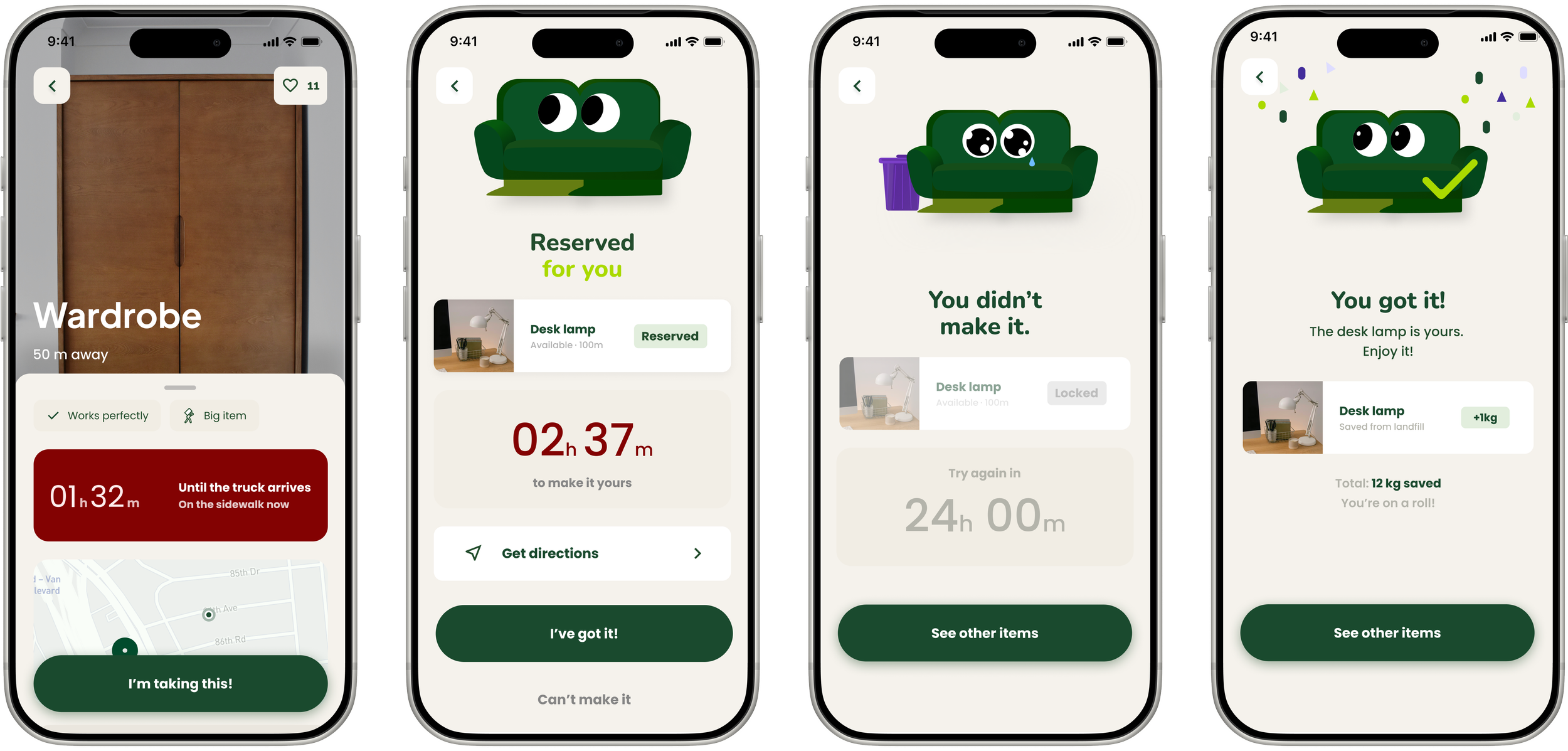
"I’m taking this" reserves the item for a window. No chat, the listing already has everything a finder needs.
FLOW 04
Post an item
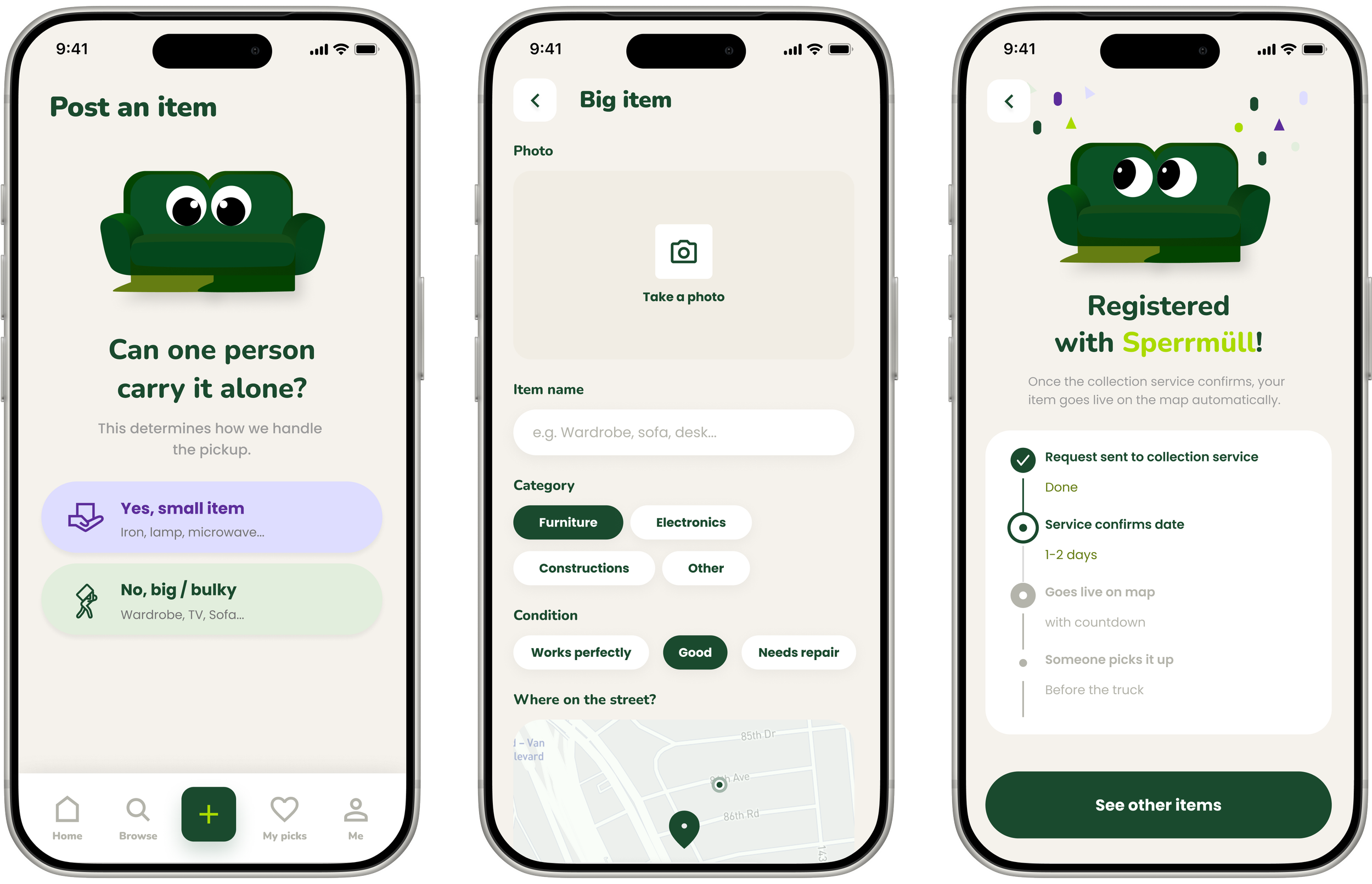
Size check first: "can one person carry it alone?" Small items stay home until claimed; big items auto-register with Sperrmüll.
Flow 05
My picks
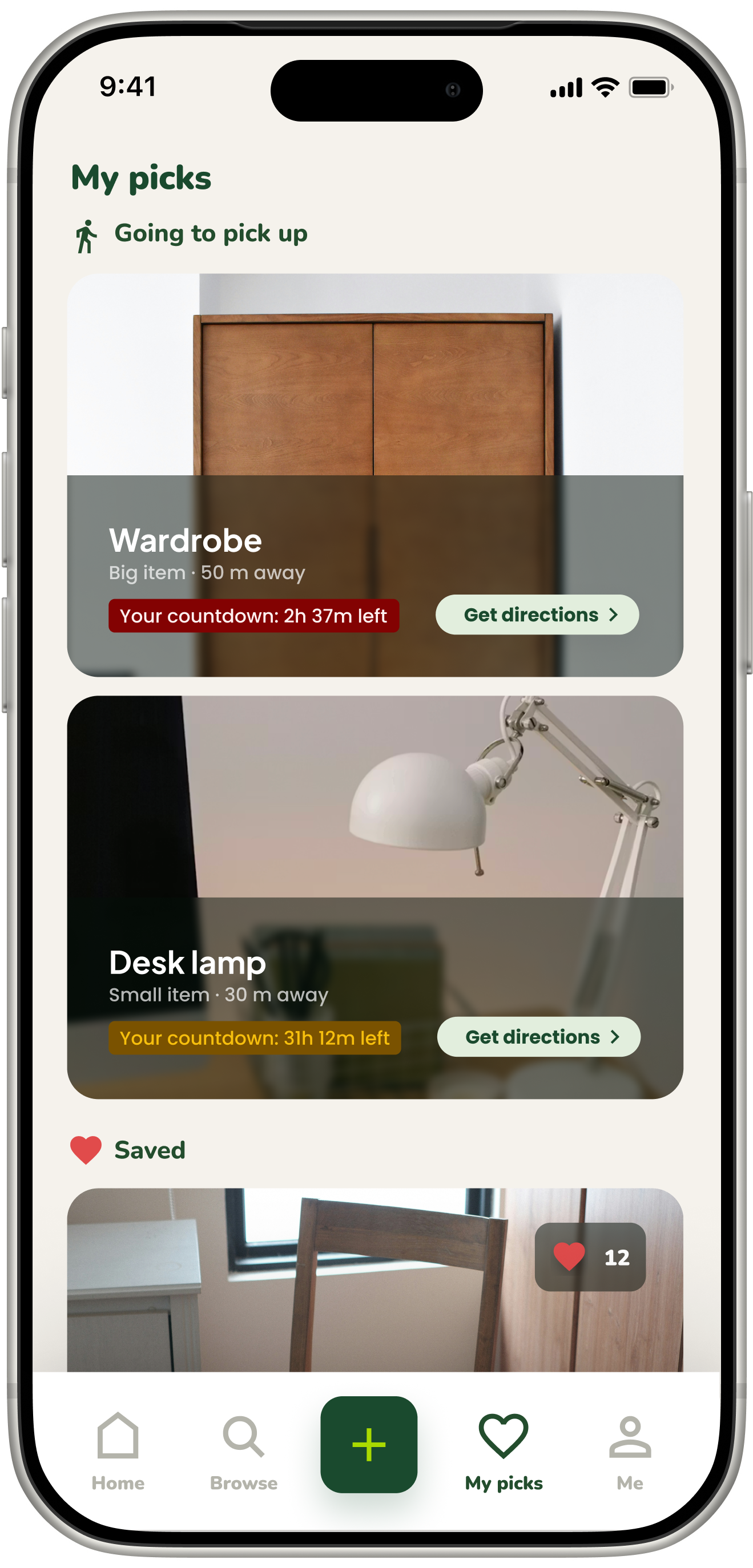
Two lists in one tab: things you’re going to pick up, and things you saved for later. Distance + deadline travel with the card.
Flow 06
Profile & impact
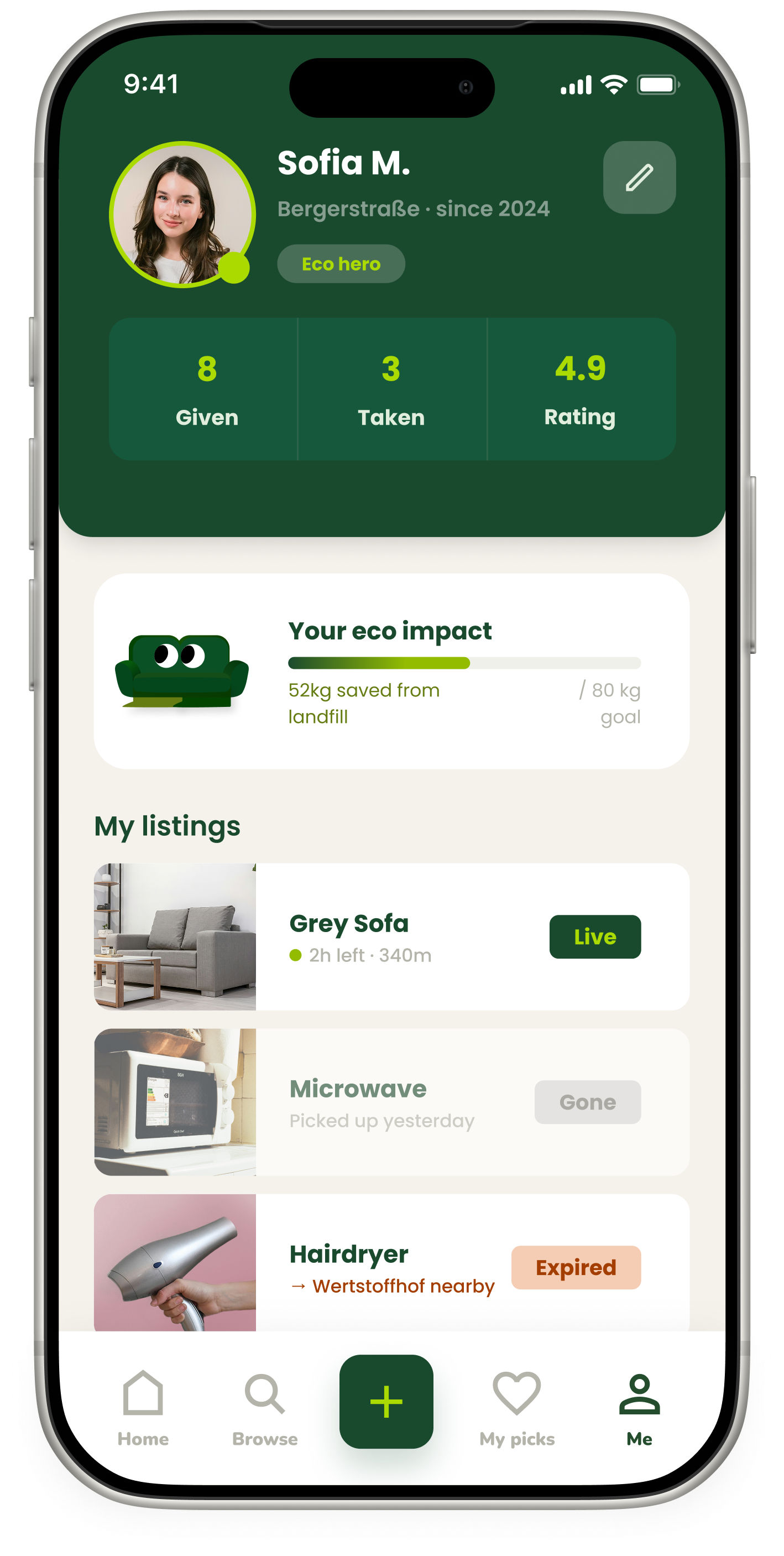
Items rehomed, kilos saved from landfill. Reward, not bait never on the home screen.
06 · SEE IT
Clickable prototype
See it in motion.
A click-through of the full flow built in Figma onboarding, browse, claim, post, and impact. Real interactions at real speed, no narration.
07 · REALITY CHECK
Four questions a real launch has to answer.
A clickdummy hides logistics. These are the awkward, real-world edges I'd have to solve before this app touches a real curb.
01
It can't be the truck's exact hour; Sperrmüll gives dates, not times. The countdown is the assigned pickup date, ticking down to midnight of that day. That gives the finder a real window without promising a precision the city doesn't.
Conflicts are rare, but they happen. When someone claims an item it's marked Reserved, visible to other users. If they don't pick up within -2h, it goes back to available. The physical object on the curb is out of reach but inside the app, the system stays fair.
02
03
Honestly, most German cities don't expose one. Two realistic paths: the user types the pickup date the city gave them when posting, or Recouch signs partnerships with municipalities to access the schedule. For an MVP, manual entry is the right call.
04